The Kabbalah, the Tarot and the Middle Way
Kenneth Chan
16. Journey to the World of No-Thing and Beyond
After the mystical experience of the revealed Daath, which now functions Yesod in Briah, we are in what is known, in Vajrayana Buddhism, as the Path of Seeing. The paths on the Tree of Life leading from this revealed Yesod to Tiphareth in Briah would enable us to unveil the third of the three Veils of Negative Existence, Ain. And, in doing so, we would be entering the World of No-Thing. Let us now look more closely at this process of journeying to the World of No-Thing.
The Tarot only depicts two of these paths: the path from Yesod to Tipareth in Briah is represented as part of the path from Tiphareth of Yetzirah to Kether of Yetzirah and is depicted as The High Priestess, while the path from Netzach to Tiphareth in Briah is represented by The Fool. While only two of the paths, here, are actually depicted by the Tarot, we can, nonetheless, deduce, to a fair extent, how the other paths function from the similarity in the nature of the paths in the different Worlds of Manifestation, in accordance with the Hermetic principle: “As above, so below.” In other words, these paths in Briah function in a similar way to their corresponding paths in the Worlds of Assiyah and Yetzirah.
The revealed Yesod in Briah, as in the earlier Trees of Life in both Assiyah and Yetzirah, represent the mystical experience that is brought forth by the Right View that is depicted by the path that links Malkuth (of Briah) to it. It is the mystical experience that comes forth upon the realization of the right view that bodhicitta and the wisdom realizing emptiness are actually one and the same. This mystical experience at Yesod in Briah (which is the revealed Daath in Yetzirah) is now a direct personal experience of this truth. And, as in the description of Yesod in Assiyah, it “proves and corrects the designing of their representations” because what was previously a view is now directly experienced as a unitive state of being.
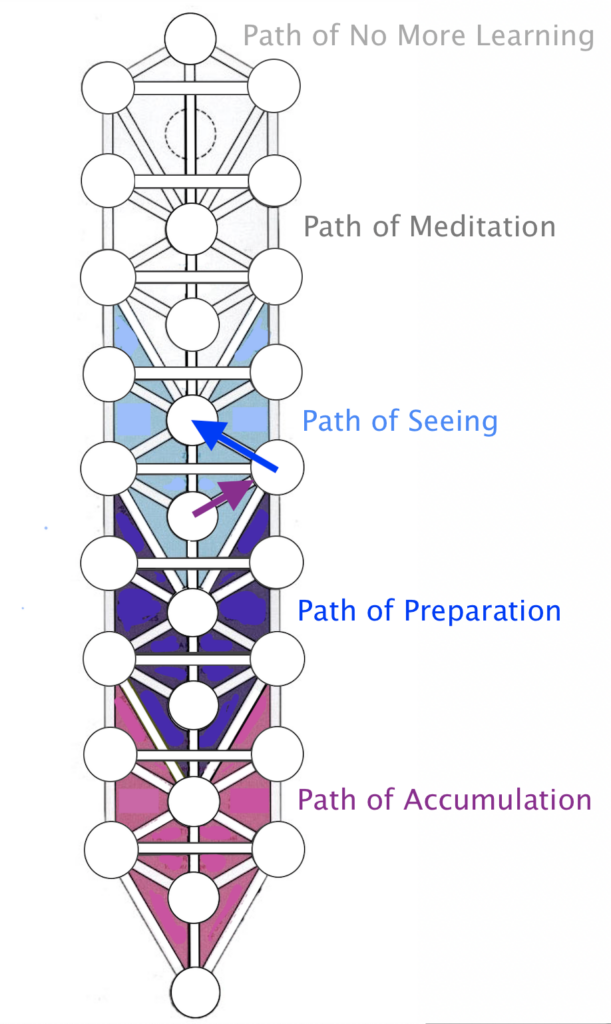
This mystical experience at the revealed Yesod would provide us with the realization, through direct experience. It is a direct realization of emptiness and its union with the principle of bodhicitta. This realization would then provide a deeper understanding of our reality and affect our core perspective via the path from Yesod to Hod. This experiential realization of the revealed Yesod would also provide a powerful inspirational drive to the aspirational aspect of our being via the path from Yesod toNetzach.
This inspirational impetus then enables the path from Chokmah to Kether (in Yetzirah) which is depicted by the Tarot card, The Fool, and by the Noble Eightfold Path as Right Action. This path represented by The Fool is thus the culmination of the process that is represented by the paths from the revealed Daath (which now functions as Yesod in Briah) to Netzach in Briah.
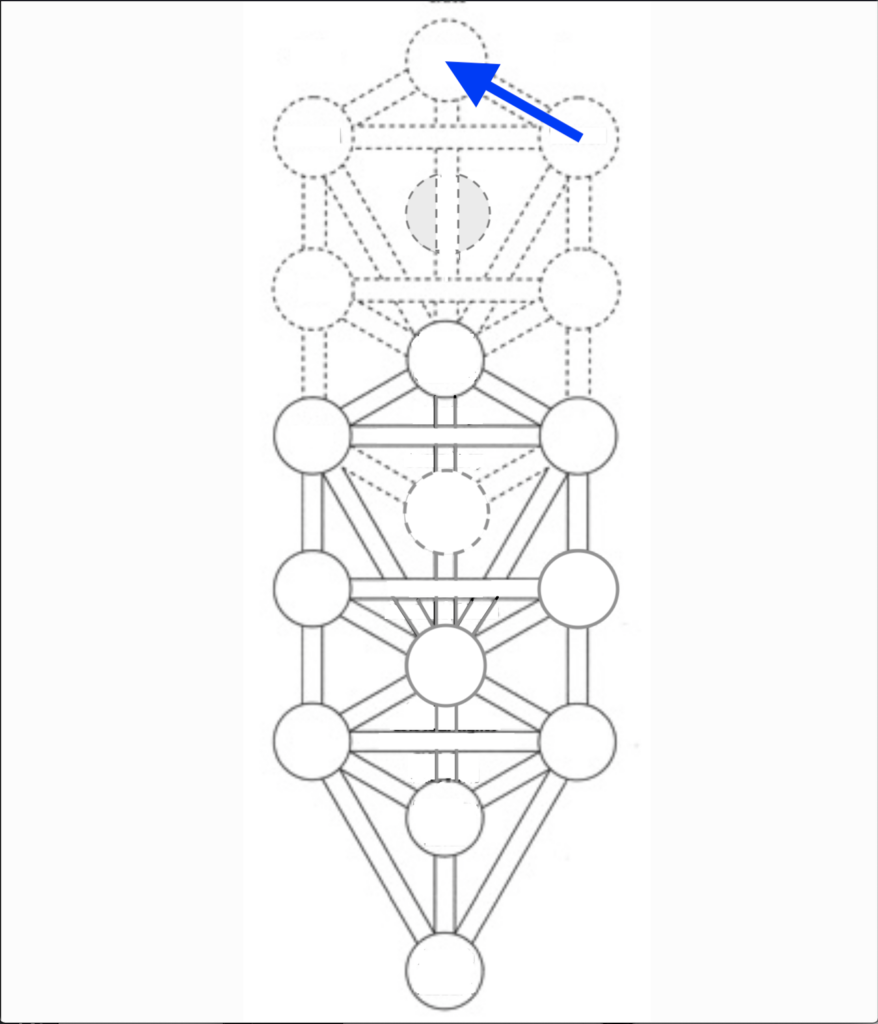
YETZIRAH: Chokmah – Kether
Tarot Card: The Fool
Noble Eigthfold Path: Right Action
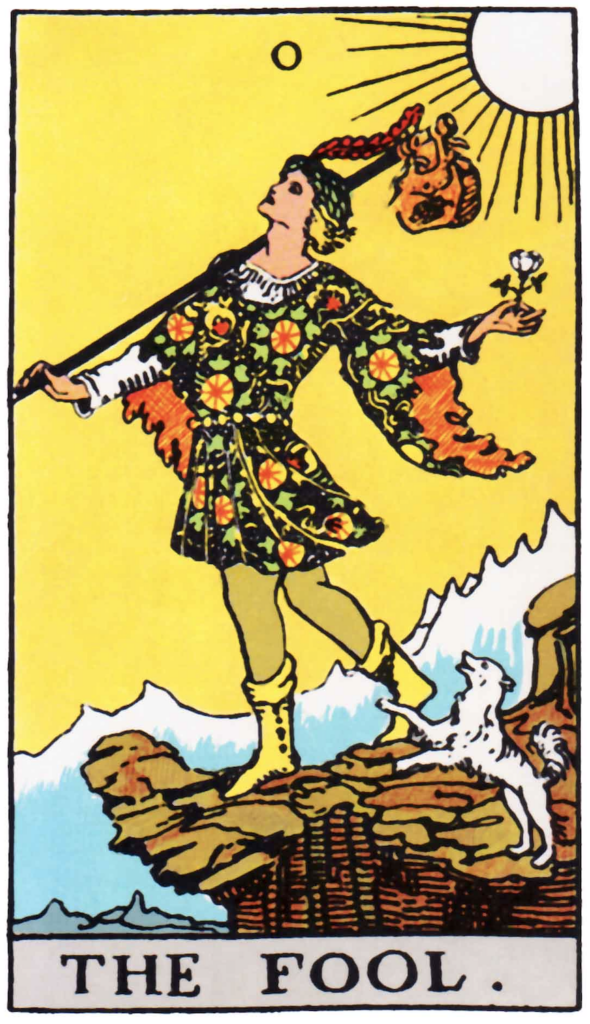
The fool spontaneously and happily steps into the void. It is important to note that this is NOT nihilism; the void here is the realization that all things are empty of inherent or intrinsic existence, that they are all only dependently arisen. Perhaps the closest analogy would be like that of realizing that all the manifestations are like that of a hologram, but also, nonetheless, that what appears in the hologram do depend on the preceding causes and conditions, as well as on the apprehension and labeling of the mind. This is the nature of the emptiness of inherent existence that the fool happily and spontaneously steps into.
As mentioned above, this direct and spontaneous realization of emptiness is the path that needs to be developed to enter into the stage of the spiritual path known, in Vajrayana Buddhism, as the Path of Seeing. This realization is gained when the aspirant takes the path from Malkuth to Yesod in Briah, which corresponds to the path from Tiphareth to the revealed Daath in Yetzirah. The mystical experience represented by the revealed Daath (which is now Yesod in Briah) provides the direct experience of emptiness, and is the reason why it is called the Path of Seeing. This is the stage where the practitioner sees the emptiness of all phenomena directly, without the need to analyze and deduce that it is so.
After attaining this direct realization of emptiness, the path from Yesod to Netzach (in Briah) acts upon the inspirational center at Netzach to embark upon the course of Right Action, which is the path from Netzach to Tiphareth (in Briah). The Tarot card, The Fool, represents this path of Right Action depicted by the Noble Eightfold Path (that is centered around Tiphareth of Briah), that follows upon the attainment of this direct realization of emptiness—The Fool is portrayed as one who readily and happily steps into this ultimate reality of emptiness.
This spontaneous and direct seeing of emptiness transforms all our actions into what are known as paramitas or transcendent perfections. Mahayana Buddhism outlines them as the six paramitas: The perfection of generosity, the perfection of moral discipline, the perfection of patience, the perfection of effort, the perfections of meditation, and the perfection of wisdom. They are transcendent because the subject, object, and practice of the perfections are all free of any sense of self. This is known as the threefold purity. As an example, in the act of seeing, there is no inherently existing self that does the seeing (i.e., no subject). There is also no inherently existing thing that is seen (i.e., no object). Furthermore, there is also no inherently existing act of seeing (i.e., no practice or action). All three are realized as being empty of inherent existence, and hence are known as the threefold purity.
When our actions are all performed in this transcendent manner, that is free of any sense of self, we are more deeply in a state of union with the All, or with the indescribable “One” that Plotinus speaks of. It is like the merging of water with water, inseparable and indistinguishable. It is the state of sunyata where even our actions are an integral part of this direct realization of emptiness.
The other path that leads to Kether in Yetzirah is the one from the revealed Death to Kether, and is the second path represented by the Tarot Card: The High Priestess.
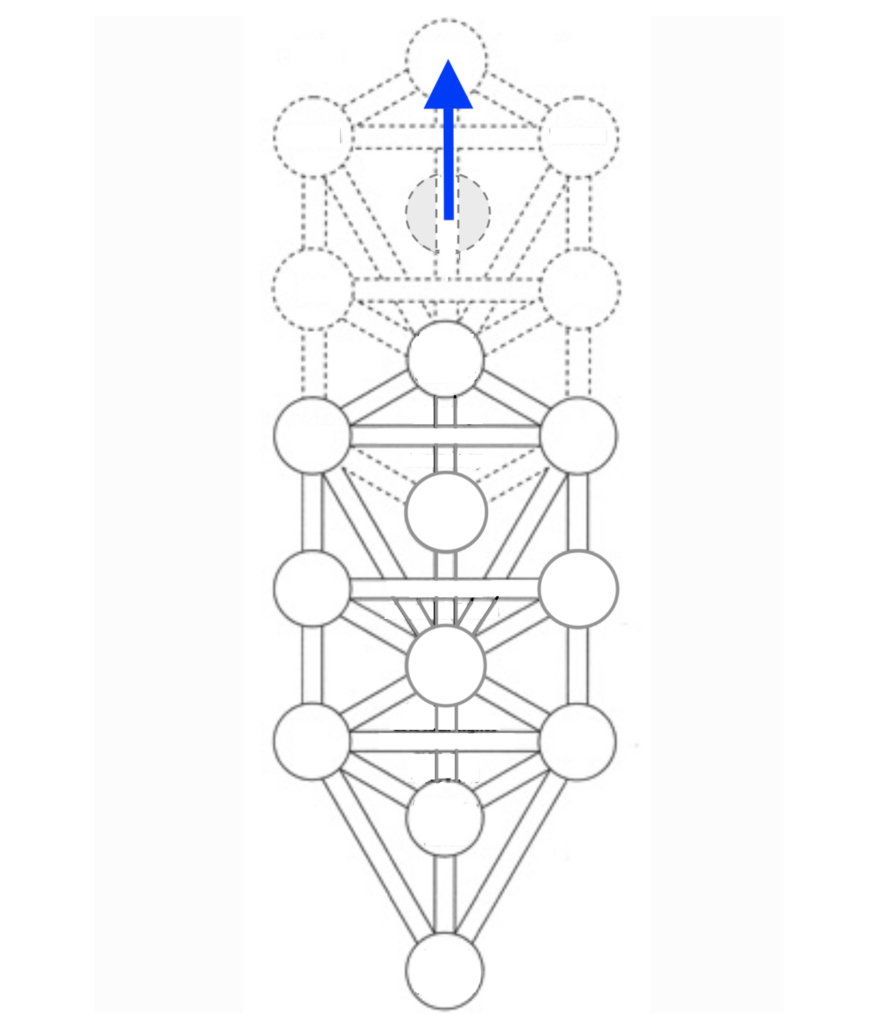
YETZIRAH: Daath – Kether
Tarot Card: The High Priestess
Noble Eightfold Path: Right Livelihood
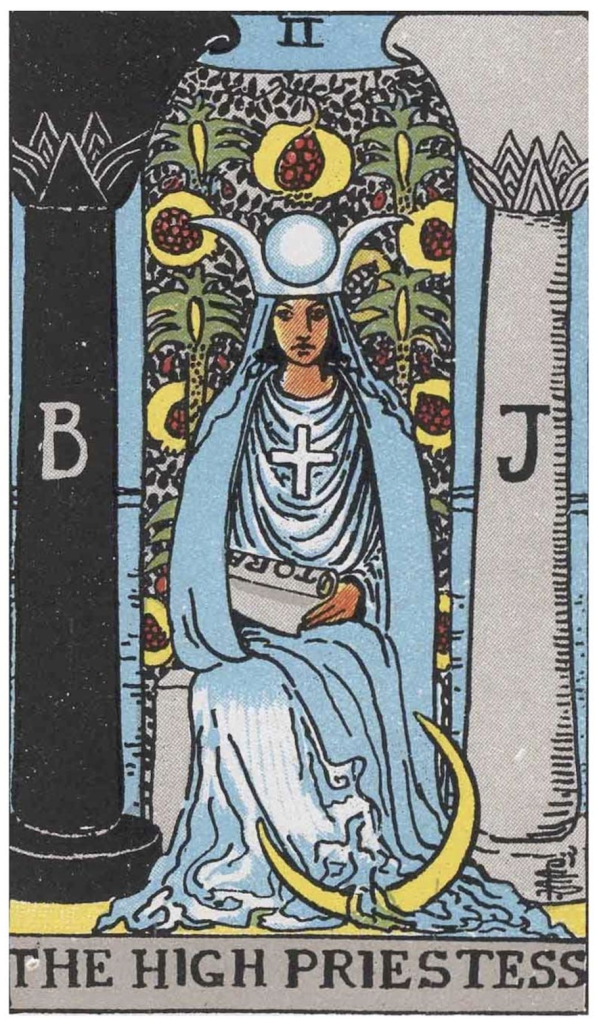
As previously mentioned, the High Priestess is seated between the two pillars with the letters B and J, which stand for Boaz and Jachin, the left and right pillars on the Tree of Life, representing the cognitive and affective aspects of our being. The Tarot Card thus depicts the path leading to the unification of bodhicitta and the wisdom realizing emptiness.
The path from Daath to Kether in Yetzirah is the second part of the path represented by the Tarot Card of The High Priestess. It is the path that functions in a similar way with the Tarot card of Temperance that depicts the corresponding path from Daath to Kether in Assiyah. Temperance represent Right Livelihood, the need to strive to maintain the realization of the mystical state of Daath in the post-mediation state or in our normal daily life.
Likewise, in the world of Yetzirah, after the mystical experience at Daath, where we experience the union of bodhicitta and the wisdom-realizing-emptiness, the state of ultimate bodhicitta, we then have to strive to maintain this realization in our everyday life, which is the meaning of Right Livelihood. And this, together with the path of Right Action (represented by The Fool) helps us to attain the higher realizational state represented by Kether of Yetzirah.
Kether of Yetzirah is Tiphareth in the World of Manifestation of Briah, the World of No-Thing. Like Tiphareth in the Worlds of Assiyah and Yetzirah, it functions in the same way as how it is described in Assiyah as “the Mediating Intelligence, because in it are multiplied the influxes of the Emanations.” Thus, through the higher paths connected to it, this realizational state of Tiphareth in Briah is progressively developed and enhanced.
When this process of progressive development of Tiphareth has reached a sufficient level of perfection, the path from Tiphareth to Hod in Briah will manifest. This is the path depicted by the Tarot Card: The Magician. And it is the last of the paths on Jacob’s Ladder that are depicted by the Tarot cards.
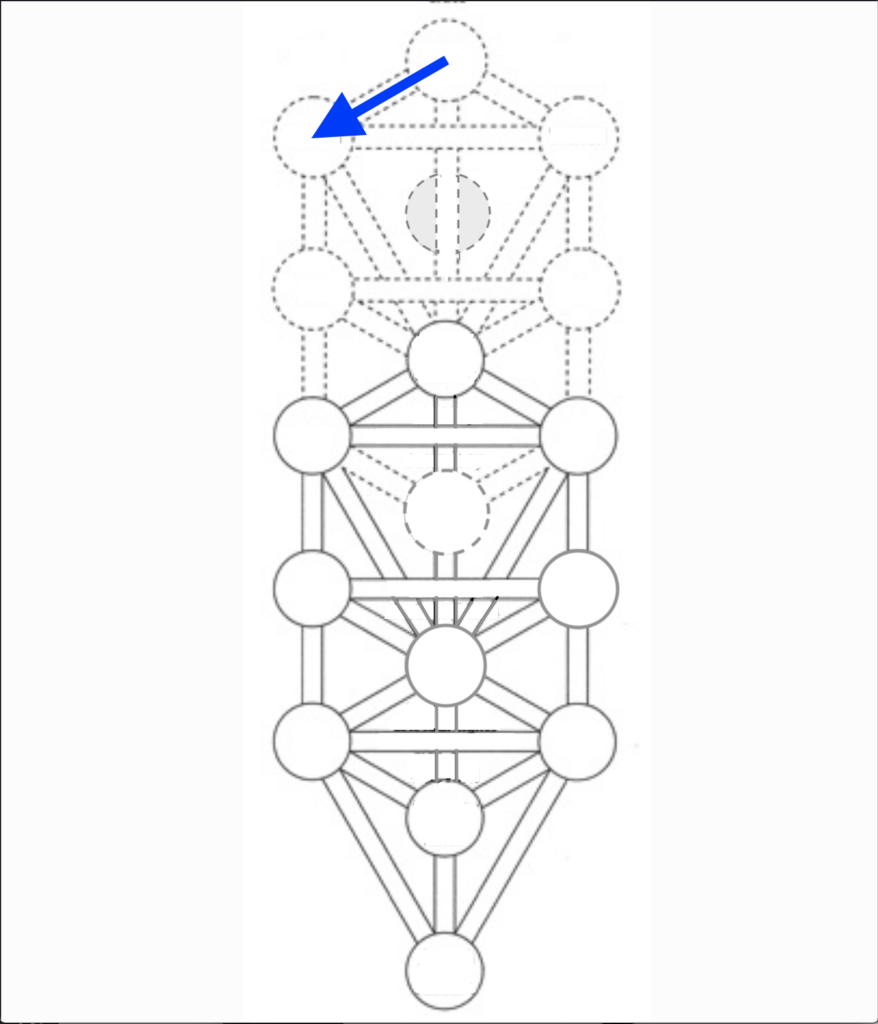
YETZIRAH: Kether – Binah
Tarot Card: The Magician
Noble Eigthfold Path: Right Effort
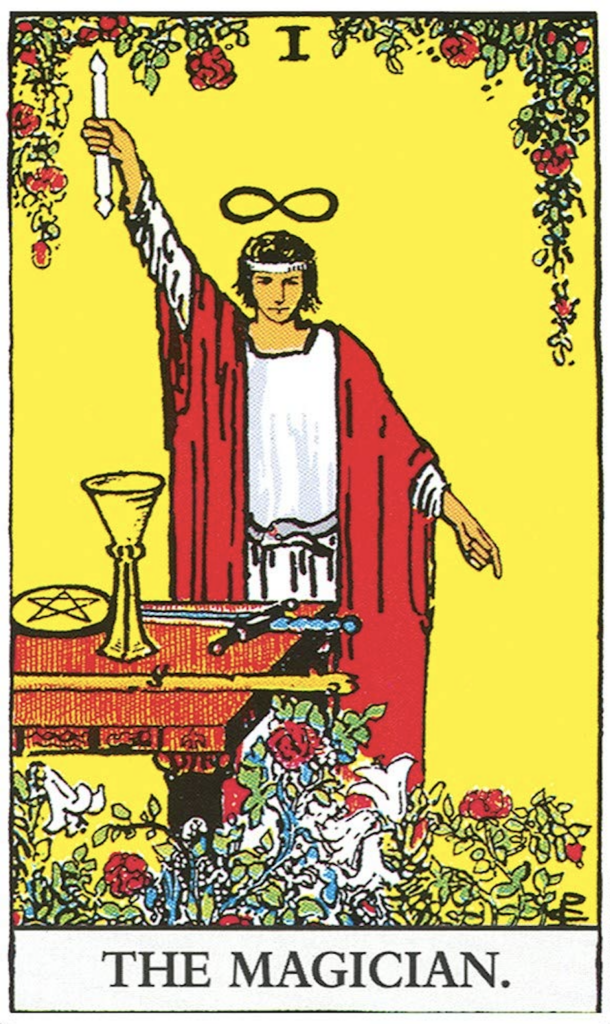
This is the path of Right Effort in the Noble Eightfold Path of the World of Briah. The Tarot Card depicts the magician channeling realizations and inspiration from Kether of the World of Yetzirah, which is also the first Sephirah in the World of Atziluth that we have reached.
Like the corresponding path from Kether to Binah in Assiyah, the path from Kether to Binah in Yetzirah (which corresponds to the path from Tiphareth to Hod in Briah) is one where the realizations and inspirations from Tiphareth is used to transform our foundational perspective in Hod.
As we progressively strive along this path towards perfecting our personality and reference perspective in Hod, we will reach a stage of Joyous Effort, where it becomes a joy to be working towards saving all sentient beings from suffering. When perfected, the effort to work towards saving all beings from suffering will be natural and spontaneous.
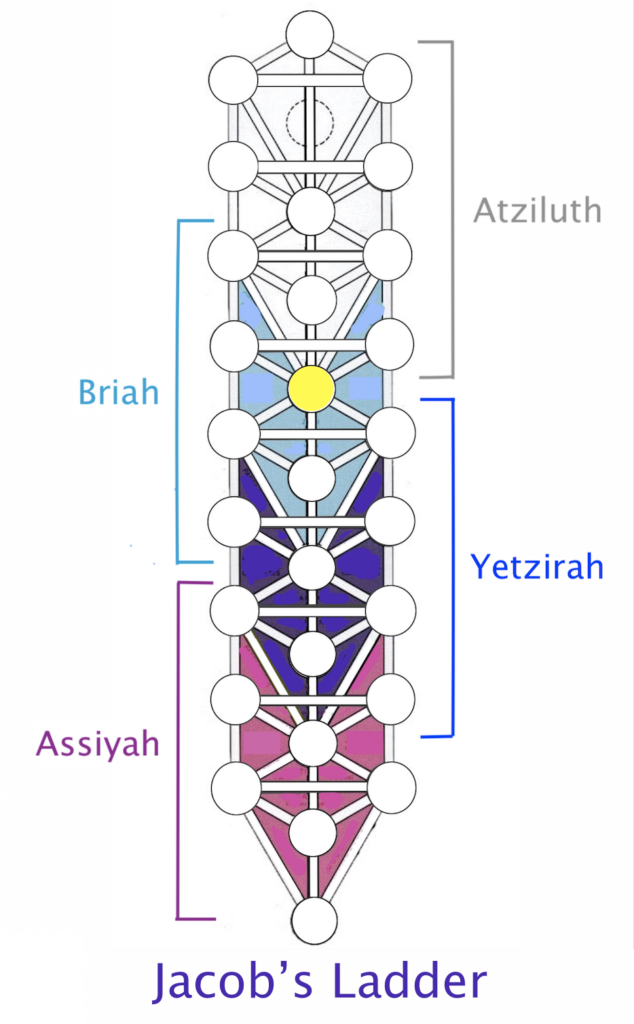
We no longer have the guidance of the Tarot cards for the paths beyond the Sephirah of Kether in Yetzirah, which is the beginning of the highest World of Manifestation, i.e., Malkuth of Atziluth. The teachings of Tibetan Buddhism, however, does provide us with information on two further objectives that are aimed for, in these higher paths on Jacob’s Ladder beyond Kether in Yetzirah.
The first, which is the objective of the Path of Meditation, is to lose the innate sense of the self. In directly perceiving emptiness on the Path of Seeing, we would already have gained the realisation of losing what is known as the acquired sense of an inherently existing self. However, the innate sense of the self is still present, although, at times, it may be hidden from view. Though it may not be overtly evident, this innate sense of the self is nonetheless present in all unenlightened beings and is what would become apparent if we are physically attacked or, often, if we are being publicly humiliated. Even after having freed ourselves from the acquired sense of the self, in these intense events, the innate concern for the self can suddenly manifest.
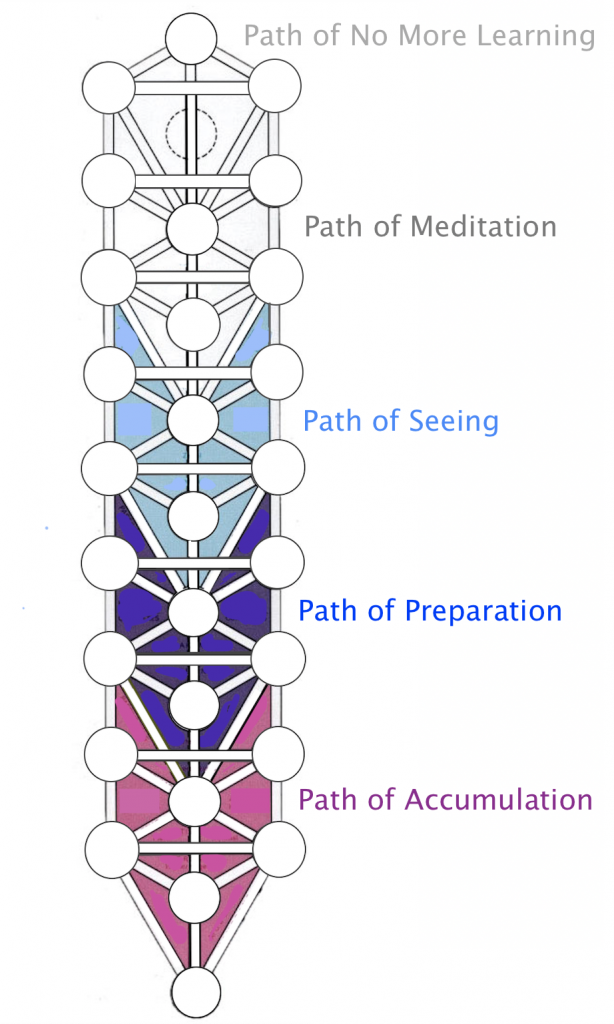
Freeing ourselves from this innate sense of the self is an immense endeavour and is a task that is undertaken in the extremely high level of Jacob’s Ladder known in Tibetan Buddhism as the Path of Meditation.
The second aim of the higher paths, beyond that depicted by the Tarot, is an objective of the Path of No More Learning, which is to attain the ability to directly perceive the union of emptiness and dependent origination, which entails the union of the Ultimate Truth and the Conventional Truth, in a single instance of mind.
The union of the Ultimate Truth and the Conventional Truth is reflected in the words of the Heart Sutra: “Form is emptiness; emptiness is form. Emptiness is not other than form; form is also not other than emptiness.”
In the words of the Dalai Lama (from“The Essence of the Heart Sutra”): “One must understand form and its emptiness in unity; they are not two independent realities.”
“Emptiness is the basis for the existence of form. In fact, in some sense, we can even say that emptiness creates form. One can then understand that statement that “emptiness is form” in terms of form being a manifestation or expression of emptiness, something that comes out of emptiness.” (end of quote)
Recall that we have said that “emptiness of intrinsic existence” and “dependent origination” can be understood in the sense of the phrase “the interplay of the elements,” only we have to remove the term “the elements” since there are no intrinsically existing elements. All we have left is the “interplay” with no actual elements. The phrase “emptiness is form” is thus essentially saying that this “interplay” is what constitutes “form.” In other words, we are saying that there is no intrinsically existing form; but that form essentially comes from this “interplay” or is a manifestation of this “interplay.” In the words of the Dalai Lama:
“Emptiness of form … is another way of saying that form arises from emptiness, and emptiness is the basis that allows the dependent origination of form. Thus, the world of form is a manifestation of emptiness.”
“Emptiness does not imply nonexistence; emptiness implies the emptiness of intrinsic existence, which necessarily implies dependent origination. Dependence and interdependence is the nature of all things; things and events come into being only as a result of causes and conditions. Emptiness makes the law of cause and effect possible.”
“Although many Indian schools of thought—both Buddhist and non-Buddhist—understand the nature of reality in terms of two truths, the more subtle understanding entails the realization of the two truths not as two separate, independent realities but rather two aspects of a single reality.” (end of quote)
The threshold that opens the door to the world of Atziluth is, at a certain level, a union of the Ultimate Truth and the Conventional Truth. It unveils the third Veil of Negative Existence, Ain (which means No-Thing). This union of Conventional Truth and Ultimate Truth is achieved at both the intellectual level and the emotive and aspirational level, since it incorporates the compassionate element of bodhicitta that arises naturally from the realization that there is no duality of “self and others” because both are empty of inherent existence.
At the level of the Path of No More Learning, the objective is to directly perceive the union of the Ultimate Truth and the Conventional Truth in a single instance of mind. While it is possible, prior to reaching this level of attainment (at the Path of No More Learning), to understand this union through a process of inferential cognition, it is a far more profound realization if it can be perceived directly in a single instance of mind. What that means is that the unity of these two truths is directly cognized without the need for any inferential process. Hence, they are directly perceived in a single instance, which is the ultimate level of realization, and is a key component of the omniscient mind.
There is no longer the possibility of a mistaken view that would need to be corrected through an inferential process which requires a succession of many instances of mind. In the tradition of Tibetan Buddhism, it is considered that only the Buddha, or the fully enlightened one, that has this ability to perceive the union of the Ultimate Truth and the Conventional Truth in one instance of mind. It is thus the highest level of the realization of sunyata.
Copyright © 2026 by Kenneth K C Chan. All Rights Reserved.
Next Page